

TL;DR
Does having more Google reviews help you show up in AI recommendations?
Not necessarily. AI models weight consistent, ongoing review signals over raw count. A profile with fewer reviews but a long, steady history can outrank one with more reviews that went quiet. The fix is a system that collects reviews after every job, not a one-time campaign.
Most electricians assume the shop with the most reviews wins. More stars, more credibility, more calls. It’s a reasonable assumption — and our Commerce audit shows it’s wrong.
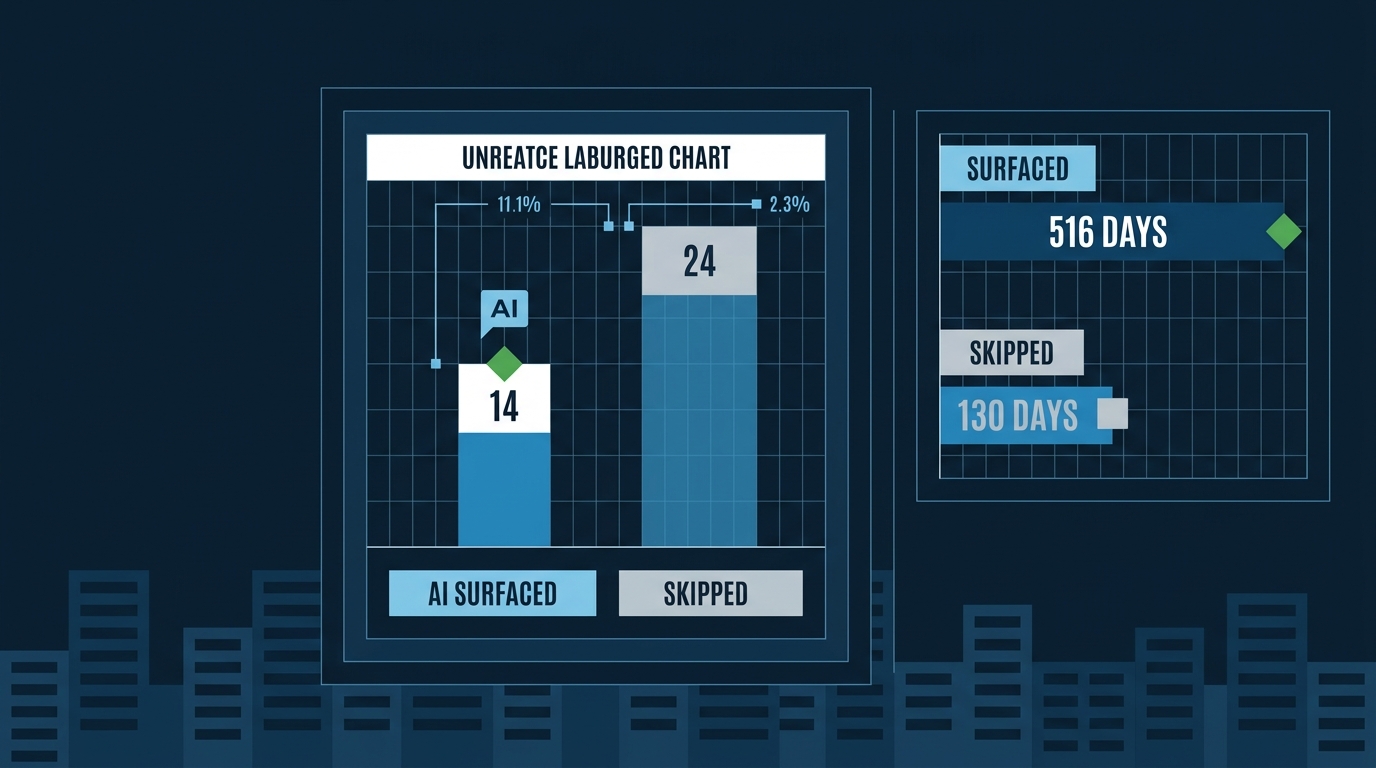
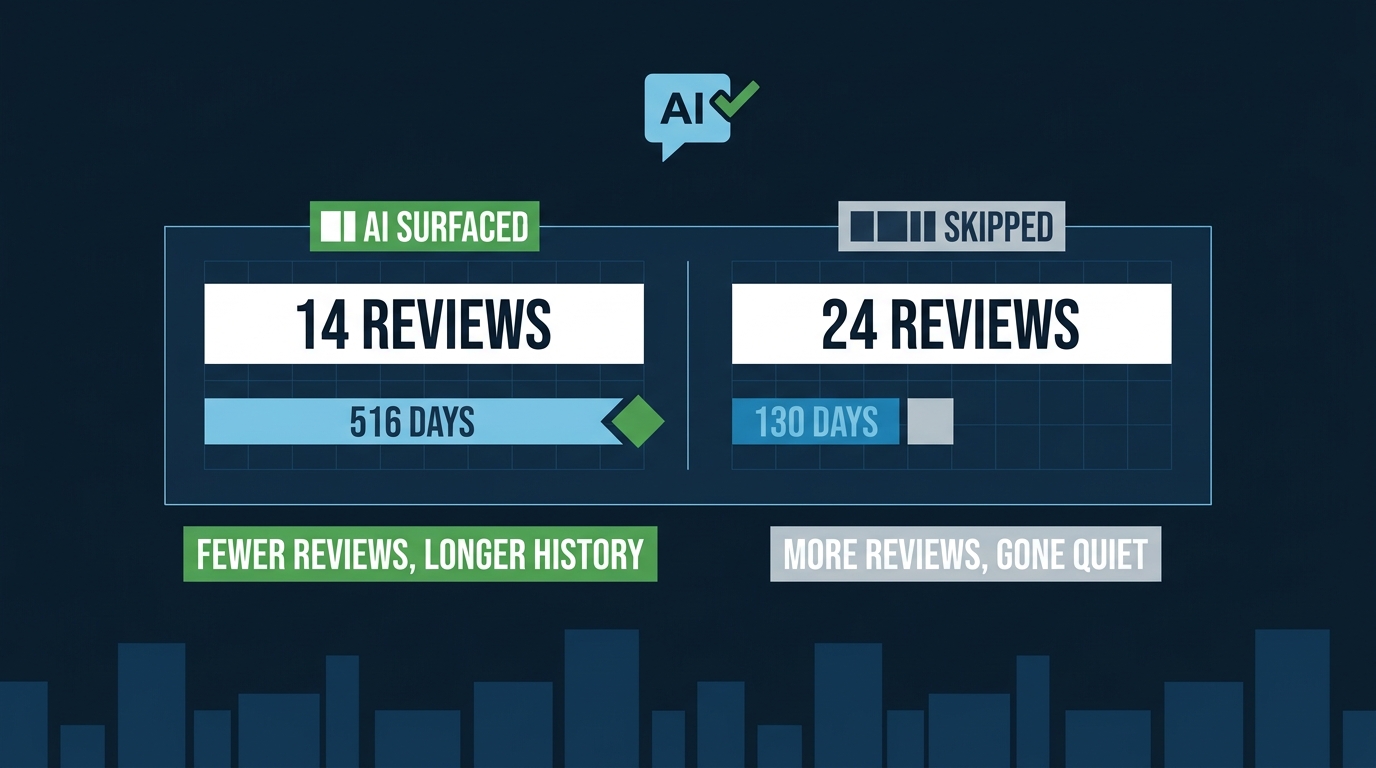
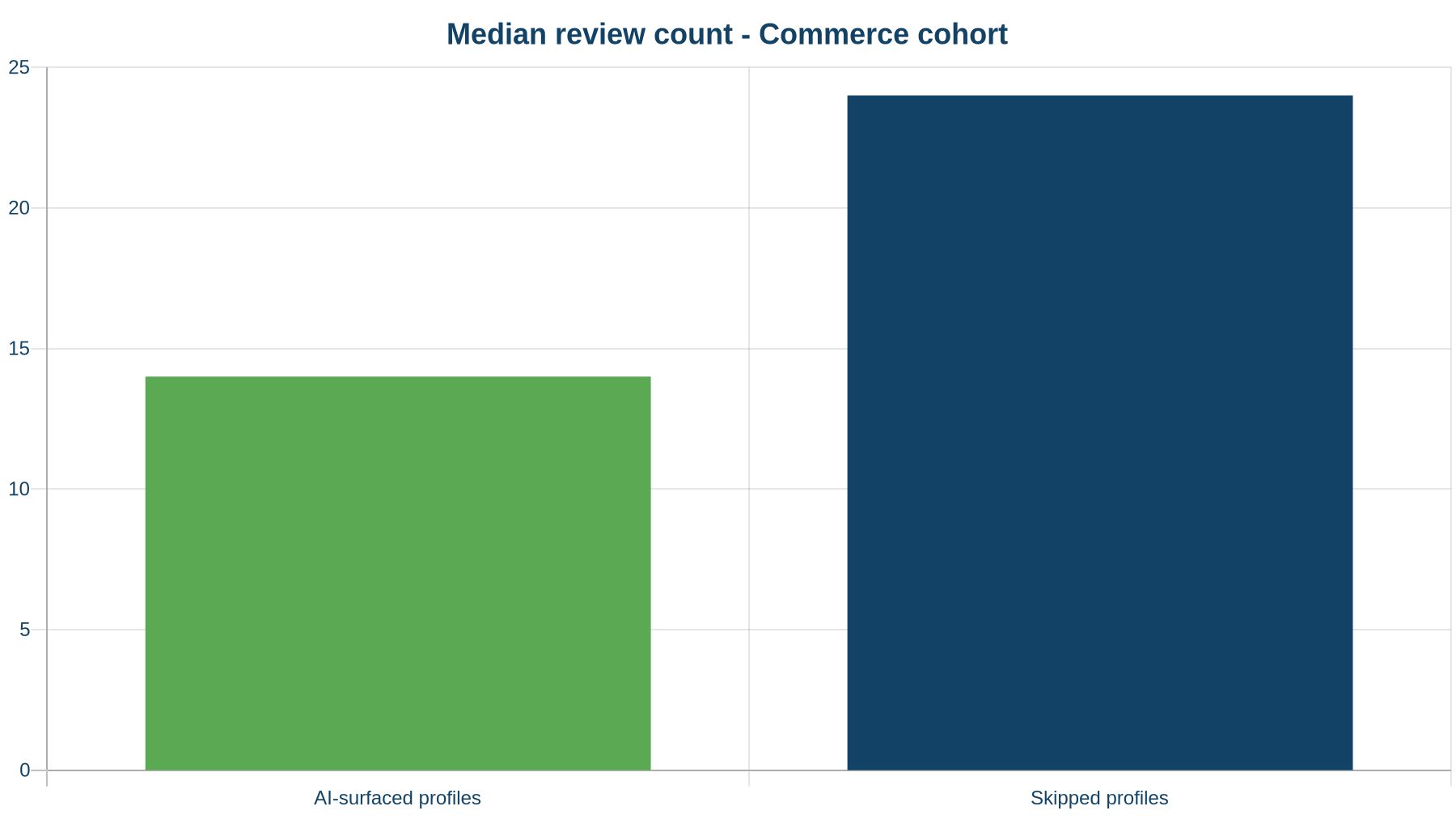
When we asked Google’s Maps-grounded AI for a best-rated electrician in Commerce, it surfaced 4 profiles out of a 14-profile cohort. The profiles it named had a median of 14 reviews. The profiles it skipped had a median of 24 reviews. The skipped group had nearly twice the review count — and still didn’t make the list.
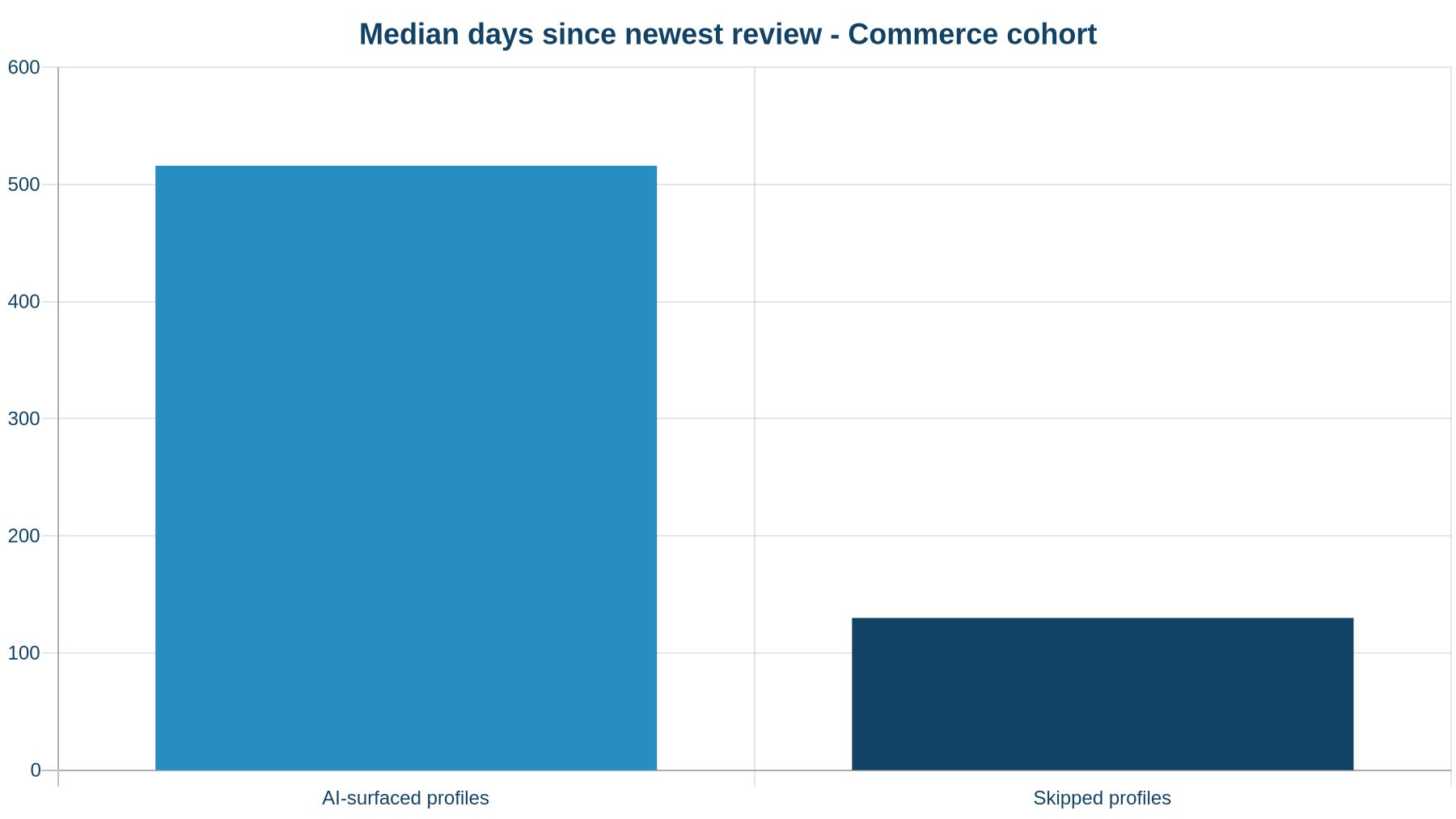
What the surfaced group had instead: older reviews. Their newest review was a median of 516 days old. The skipped group’s newest review was a median of just 130 days old.
Wait. The AI picked the profiles with staler reviews? That seems backwards — until you understand what’s actually happening here.
The Shortlist Exists Before the Search Runs
Here’s the mechanic that changes everything. When someone asks ChatGPT “who’s the best electrician near me,” the model doesn’t start from scratch. Research by Suganthan Mohanadasan at Snippet Digital shows that ChatGPT writes brand names into its own search queries before fetching a single webpage. Those names come from the model’s training data — what it already “knows” about who’s credible in a category.
That means the decision about who gets considered happens before your website is ever visited. Miss the shortlist and, as Mohanadasan puts it, “your website never gets looked at, however well built it is.”
For a home-service business, that shortlist is built on trust signals the model has absorbed over time: consistent review presence, verified credentials, complete profile data. Not a single spike of reviews from two years ago. Not a burst campaign that ran for three months and stopped.
This is what the Commerce data is actually showing. The surfaced profiles have been around long enough, with enough consistent signals, that the AI model already has them in its mental shortlist. The skipped profiles — despite having more reviews — built that count in a burst and then went quiet. The model sees a burst-and-cliff pattern and treats it as a yellow flag. A dormant-but-established profile outranks a recently active one it doesn’t yet know.
What the Commerce Cohort Looks Like
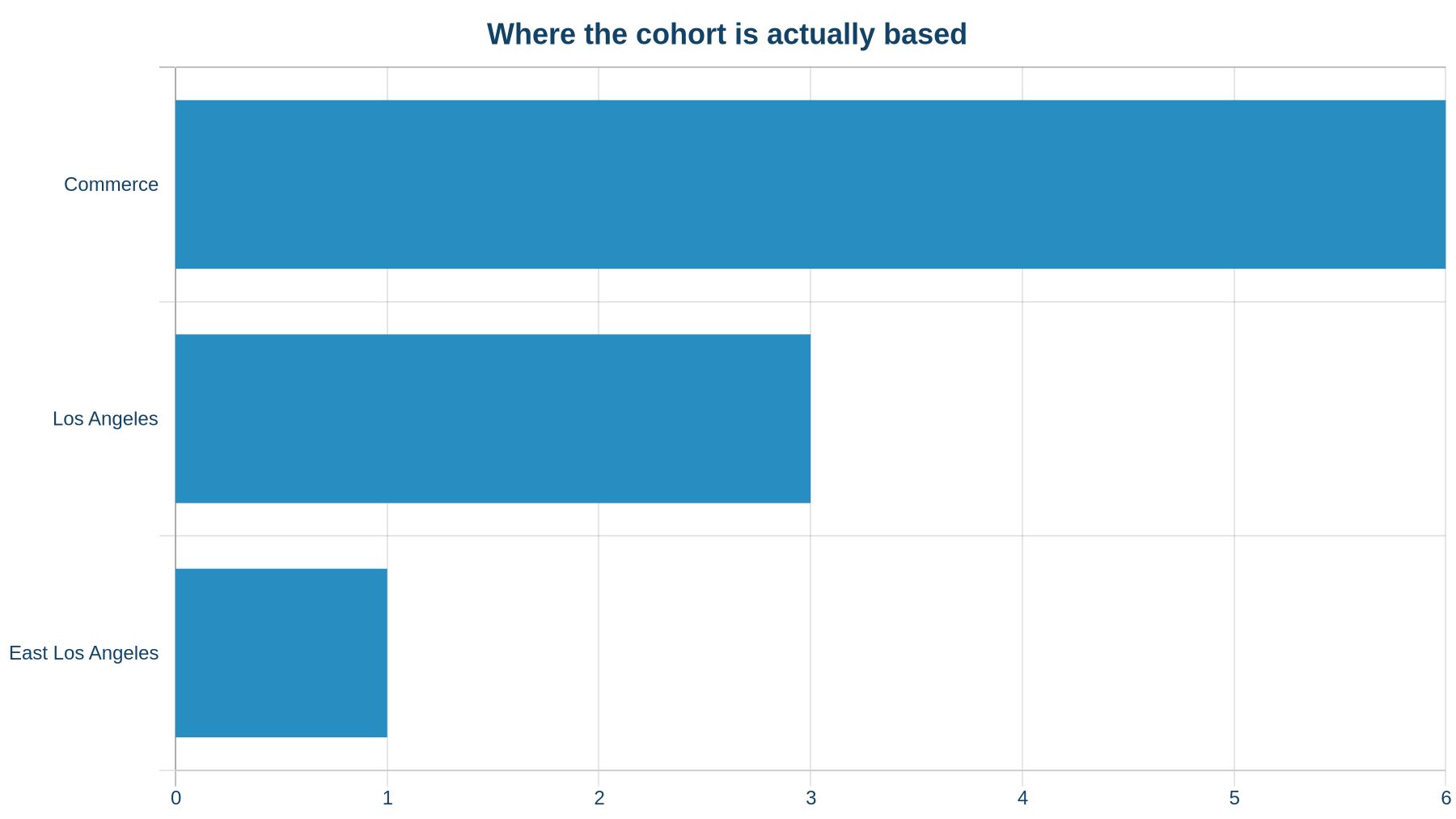
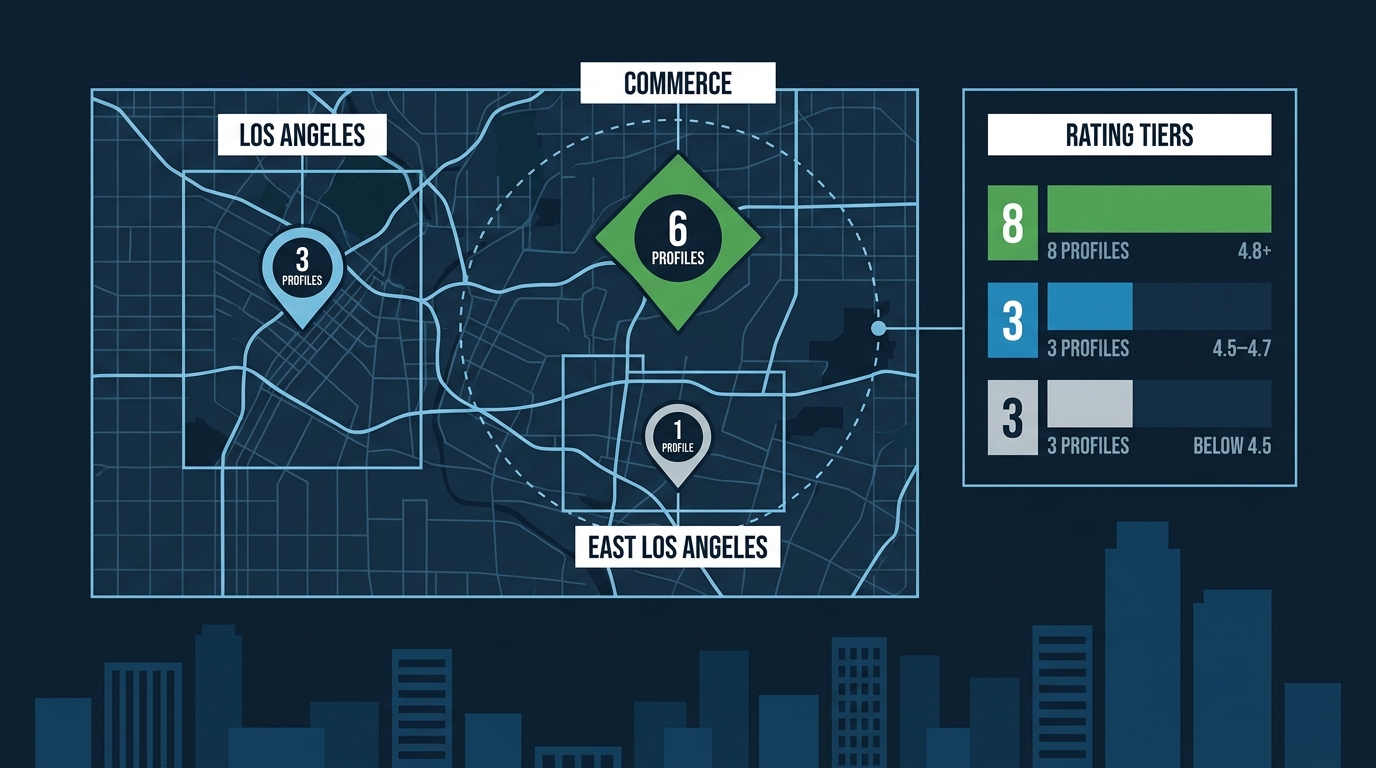
Fourteen electrician profiles compete for searches in and around Commerce, a city of about 13,000 people in southeast LA County. The cohort density is thin — 0.18 profiles per square kilometer within five kilometers of Commerce. Only 6 of those 14 profiles are physically based in Commerce itself; the rest come from Los Angeles (3 profiles) and East Los Angeles (1 profile), among other nearby cities.
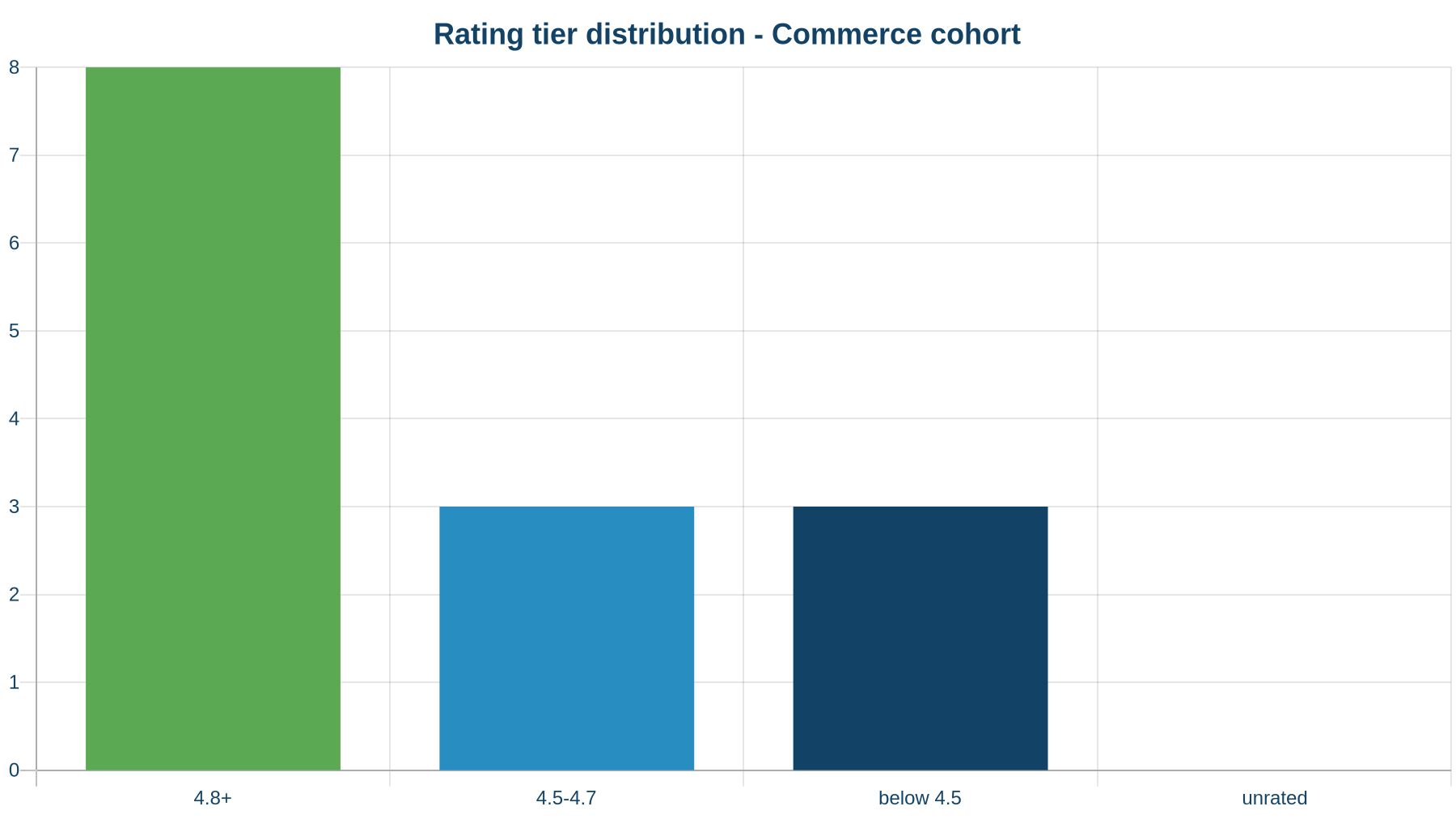
On ratings, the cohort skews high: 8 of 14 profiles sit at 4.8 stars or above. Three more are in the 4.5–4.7 range. Three fall below 4.5. Zero are unrated — meaning every profile in this market has some review history. That makes rating alone a weak differentiator. Everyone’s above a 4. The fight is elsewhere.
The fight is in recency and consistency.
Profile A — a surfaced profile — has 12 reviews, the newest of which is 860 days old. Profile B — a skipped profile — has 27 reviews, the newest just 133 days ago. Profile A made the AI’s list. Profile B didn’t. Profile A sits at the older end of the surfaced group — the cohort median for surfaced profiles is 516 days — but the pattern holds across all four surfaced profiles. Profile B is doing more of what most people think of as “review management,” and it’s still invisible to the AI.
That’s what this data points to: a well-established review presence, even if it’s been dormant for a couple of years, carries more weight in an AI model’s training than a recent surge on a profile the model doesn’t yet know.
What This Means for Your Review Strategy Right Now
The answer isn’t to stop collecting reviews. It’s to never stop.
The problem with burst campaigns — “let’s ask everyone for a review this month” — is that they create a spike and then a cliff. The model sees the cliff. Worse, the next time someone asks an AI assistant who to call for electrical work in Commerce or East LA, your profile looks like a business that was active two years ago and has since gone quiet. That’s not a trust signal. That’s a yellow flag.
In a 14-profile cohort this thin, one dormant profile dropping off the AI shortlist shifts a meaningful share of AI-referred calls to a competitor. Commerce isn’t a crowded market — which means the stakes of going quiet are higher, not lower. There aren’t enough profiles to absorb the loss.
Research from Search Engine Journal on AI visibility metrics makes the same point from a different angle: traditional metrics like rankings and click-through rates only measure what happened after a decision was made. The real opportunity is in what influences the decision before it’s made — the trust signals baked into an AI’s shortlist before it ever runs a search. Review velocity is one of those signals.
The Freshpet case study covered by Search Engine Journal illustrates the same principle at a brand level: AI citations require “trust signals the system can verify about the brand itself.” A business can hold the top Google ranking and still get skipped by an AI Overview that names three competitors instead. The fix, as Freshpet’s team found, is buildable — but it requires consistent, ongoing signal-building, not a one-time push.
For a trades business, that translates to one thing: you need a system that asks every customer for a review, every time, automatically — not a campaign you run when you remember to.
Our reputation and review management service does exactly that — automated review requests after each job, monitoring, and professional responses so the pipeline never stops. If you want to see where you stand before making any changes, run your profile through our free Does AI Recommend You? tool, which asks ChatGPT, Perplexity, and Gemini who they’d name for your trade in your city and shows whether you’re on the list.
The Monday Morning Move
Pull up your Google Business Profile and look at your most recent review. How old is it?
If it’s more than 60 days ago, you have a recency problem — and that problem is quietly costing you AI visibility right now, before a single person even clicks anything.
Set up a post-job text that goes out to every customer within 24 hours of closing a ticket. Keep it short: thank them, one link, done. Do it for every job, not just the ones that went perfectly. The goal isn’t a burst — it’s a stream. A steady stream is what the AI model learns to trust.
Your review strategy and your AI visibility strategy are the same strategy. Start treating them that way.