TL;DR
How should SGV roofers, plumbers, and HVAC crews prepare for the forecast super El Niño?
Forecasters put strong odds on a top-tier El Niño peaking this winter, and past events have doubled Southern California's rainfall. Storm demand arrives as a surge of emergency searches, won by whoever already has the rankings, reviews, and instant lead response in place. Fix your profile, review pipeline, and missed-call follow-up before the first storm.
NOAA’s forecasters don’t use the word “super” lightly. Right now they’re putting a 63% probability on a very strong El Niño peaking between November and January — and an 81% chance the October-through-December stretch lands among the largest El Niño events in the record books going back to 1950. Some models are running hot enough that, if they verify, this would be the strongest event ever measured.
If you run a roofing, plumbing, HVAC, or electrical company anywhere in the San Gabriel Valley, that forecast is not weather trivia. It’s a demand forecast.
What a top-tier El Niño has actually done to SoCal
The two biggest El Niño winters in living memory tell you the range.
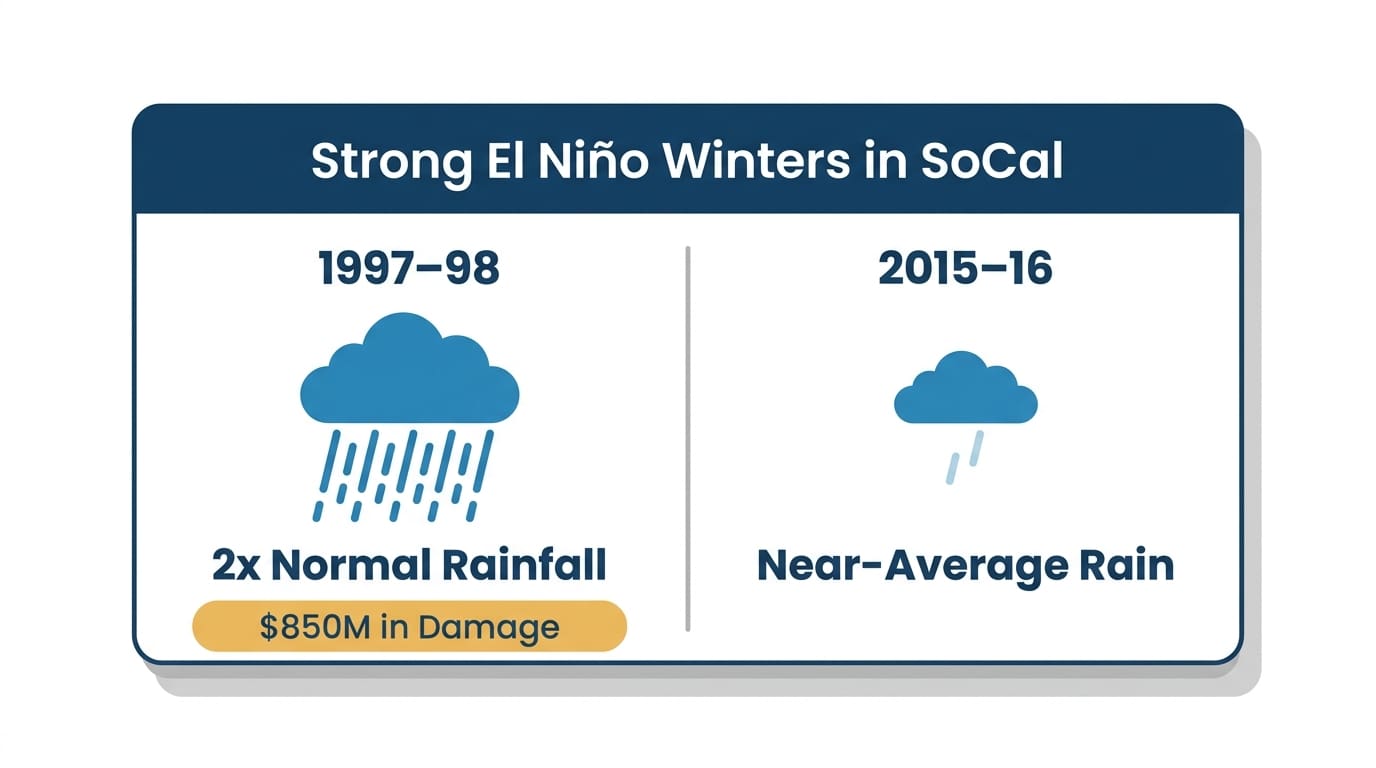
1997–98 was the one people still talk about. Southern California saw roughly double its normal rainfall, one of the wettest winters on record, and about $850 million in flood and storm damage statewide. Roofs that had quietly leaked for years failed in a single February. Hillsides moved. Storm drains lost.
2015–16 is the honest counterexample. By some measurements it was the strongest El Niño ever recorded — and Southern California got roughly average rain. The storm track set up wrong, and the “Godzilla El Niño” everyone braced for mostly missed us.
So no, a strong forecast isn’t a guarantee. But here’s the thing about running a trades business: you don’t need a guarantee to prepare. You need to know the odds, and the odds this year are tilted harder toward a wet, stormy winter than they’ve been since 2015. NOAA has the event at 97% likely to persist through early spring.
What it means, trade by trade
Roofing. This is the big one. Roof leaks don’t generate service calls in October — they generate them the night of the first real storm, all at once, from every house that skipped maintenance for a decade. The crews that win an El Niño winter are the ones booked solid on inspections and repairs in September and October, then positioned for the emergency wave when it hits.
Plumbing. Saturated ground and back-to-back storms mean sewer backups, failed sump pumps, and drainage jobs. Most SGV homes have never needed a sump pump. In a 1997-class winter, plenty suddenly do.
Electrical. Storm outages, water intrusion into panels, surge damage, downed service lines. Emergency electrical searches track storm events almost one-to-one.
HVAC. A wet El Niño winter in the SGV runs cool and damp — heating systems that sat idle through mild winters get stress-tested, and moisture problems (condensation, mold in ductwork) follow the rain.
Painters and general contractors. The window for exterior sealing, waterproofing, and stucco repair closes when the rain starts. That’s a September–November urgency story your customers haven’t thought about yet.
Landscaping and pest control. Erosion control and drainage regrading before the rain; termite and ant surges after it. Wet years are boom years for both.
The part nobody plans for: demand arrives as searches
Here’s what actually happens on the night of the first big storm. A few thousand SGV homeowners discover water where water shouldn’t be, and they all grab their phones and type the same things: “roof leak repair near me.” “Emergency plumber Alhambra.” “Flooded garage what to do.”
Google decides who gets those calls — and it decides based on signals that were locked in weeks before the storm. Profile completeness. Review recency. Whether your services list actually says “emergency tarping” and “storm leak repair.” Whether you have a page that answers the question they’re asking at 11pm.
The same goes for paid. Storm demand floods the ad auction too — every roofer in the valley suddenly bidding on the same emergency keywords. If you haven’t decided your budget and set up your campaigns before the spike, you’re either overpaying in a panic or sitting it out.
The before-the-first-storm checklist
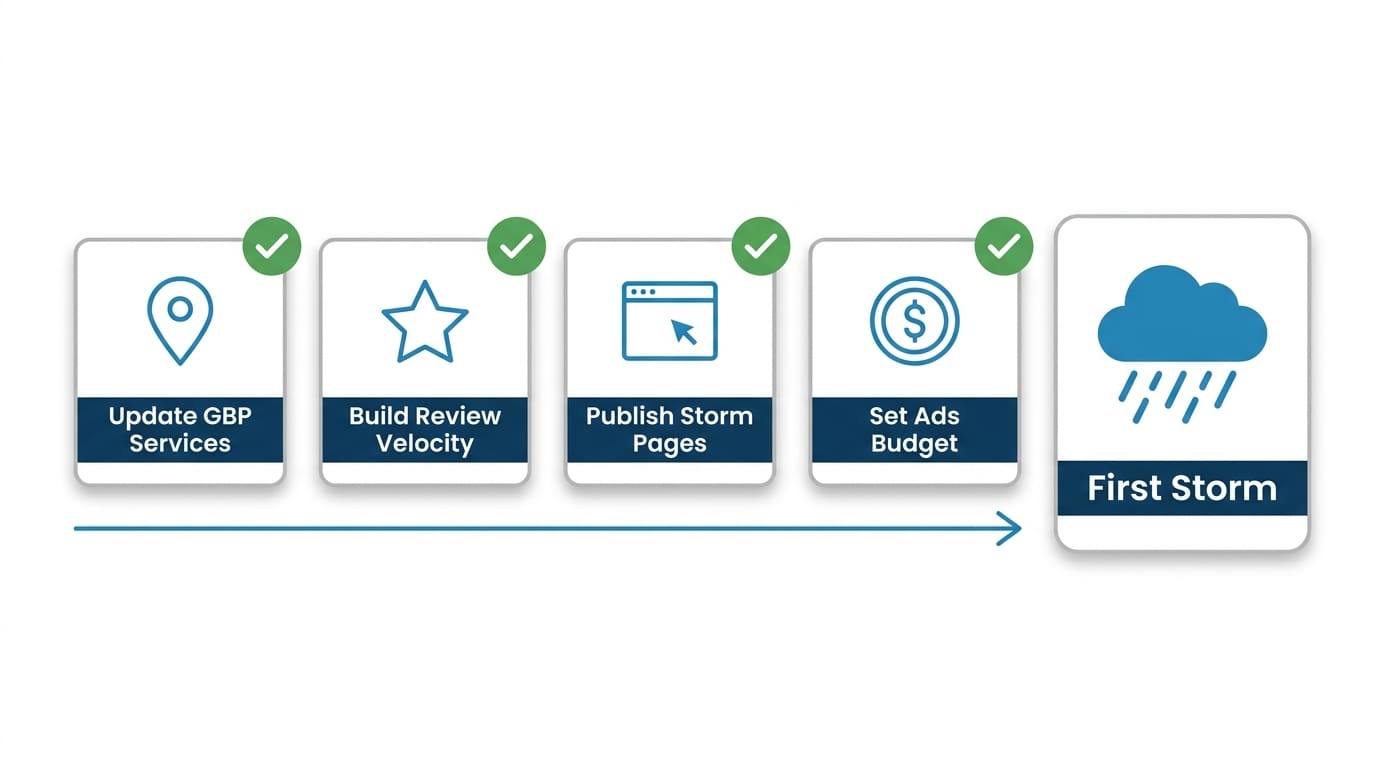
- Update your Google Business Profile services now. Add the storm work explicitly — emergency tarping, leak detection, sump pump installation, panel inspection — each with a real description. Google’s AI answers customer questions from this list.
- Build review velocity through the fall. Review recency is one of the strongest signals deciding who Google surfaces — our own audits across SGV trades show surfaced businesses with reviews weeks old, skipped ones with reviews months old. Start the ask-every-customer habit now, not in December.
- Publish your storm pages before the storm. A real page for “roof leak repair in [your city]” published in October has time to index and rank. The same page published mid-storm helps nobody.
- Size your ads budget against storm-season auction prices, not summer ones. Know what emergency clicks clear at in your city and decide your ceiling in advance. Our free Google Ads Cost Estimator shows real cost per click and bid ranges for your trade in your Los Angeles County city.
- Have an after-hours answer. Storm calls come at night. If nobody picks up, the caller dials the next name Google shows them.
The asymmetric bet
Maybe this winter lands like 2015–16 and mostly fizzles. If so, you’ve spent a few hours and a modest budget making your business easier to find — which pays for itself in any weather.
But if it lands like 1997–98, the SGV trades that prepared in the fall will have their best quarter in years, and the ones that didn’t will spend it watching competitors’ trucks drive past. The forecast says prepare. The downside of preparing says nothing.
If you want a straight answer on where your profile stands before storm season — what Google’s AI sees, where your reviews sit against the businesses it’s already surfacing, what emergency clicks cost in your city — that’s exactly what our Local SEO audits cover. Request the free one and the report lands in five to ten minutes.
Sources
- NOAA Climate Prediction Center — ENSO Diagnostic Discussion
- weather.com — El Niño poised to ‘rank among the largest El Niño events in the historical record,’ NOAA warns (July 2026)
- Golden Gate Weather Services — El Niño, La Niña and California Flooding
- LAist — How El Niño Soaked SoCal Over The Last 80 Years